
COMING UP WITH IDEAS IS EASY; PUTTING THE BELL ON THE CAT IS HARD
Sometimes we come up with wonderful ideas to solve a problem. Everyone likes them, and people even wonder why no one thought of them before. But things change when it comes time to put those ideas into practice. After all, suggesting a solution and actually making it happen are two different things. The story of the mice and the cat illustrates this perfectly.
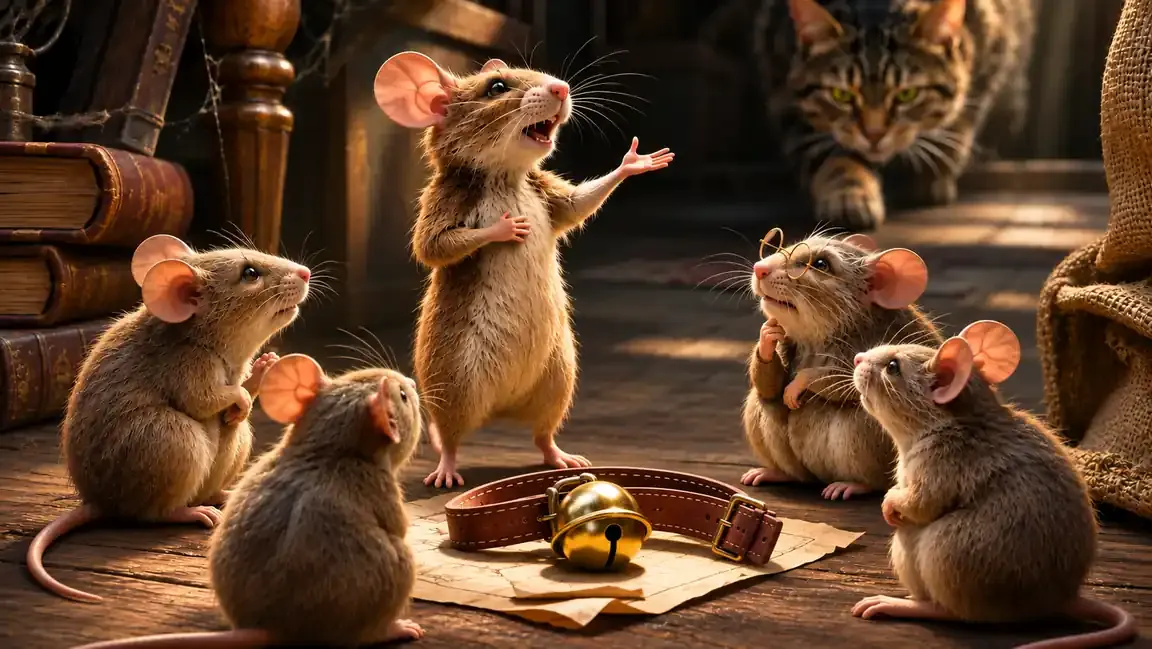
A group of mice lived in constant fear in a large house. The reason was simple: a big, fast, and ruthless cat lived there too. Every day, one of the mice would disappear. The others went on living, knowing that one day the same thing might happen to them. They could hardly sleep at night, and even the slightest sound sent them looking for a hiding place.
Finally, the mice decided to get together and find a way out of their situation. One of them spoke up:
"We can't go on living like this. We have to find a way to deal with this cat."
Everyone began offering suggestions. Some proposed finding better hiding places, others suggested running faster, and a few even recommended moving to another house.
Then a young mouse stood up and spoke with confidence:
"I have a brilliant idea. Let's put a bell around the cat's neck. That way, whenever it comes near us, we'll hear the bell. We'll know danger is approaching and have time to hide."
All the mice loved the suggestion.
"Brilliant!"
"That's exactly the solution we need!"
"The cat will never catch us by surprise again!"
Everyone congratulated the young mouse. It really did sound like a clever idea. For the first time, the mice imagined they might leave a meeting feeling safe.
Just then, an old mouse who had been sitting quietly in the corner stood up. He looked around and asked a single question:
"But who is going to put the bell around the cat's neck?"
Suddenly, everyone fell silent. The mice who had been applauding so enthusiastically moments earlier began looking at one another. No one had an answer. Some lowered their heads; others looked away.
At last, they understood the problem. Putting a bell around the cat's neck was indeed a good idea, but finding the courage to do it was another matter entirely.
The meeting ended quietly. The bell was never put around the cat's neck, and the cat continued hunting the mice as before.
This story makes me think not only about the fear of those mice but also about how people and organizations respond when faced with problems.
Most of us have attended meetings like this at some point. Everyone talks about the problems and offers solutions. Some come up with creative ideas, while others explain at length what needs to be done. Everyone has something to say, and everyone seems to have the right answer. But when it comes time to put those suggestions into practice, the room suddenly goes quiet.
Coming up with ideas is easy. From the comfort of our seats, we can tell others exactly what they should do. We can even draw up impressive plans without taking any responsibility ourselves. But turning those plans into reality sometimes means taking risks, facing criticism, and accepting responsibility for the consequences.
We see this particularly often in organizations. Everyone complains that things aren't working well. People notice what is going wrong, understand the problems, and explain how things should be fixed. But when it comes time to take responsibility and make changes, many step back. No one wants to disturb their peace, face criticism, or challenge the established order. In the end, the same problems keep being discussed, but nothing changes.
Of course, not every good idea can or should be put into practice immediately. We first need to consider the possibilities and the risks. Courage doesn't mean rushing blindly into danger. But constantly talking about risks and never taking a single step forward is no solution either.
I believe the central message of this story is simple:
"We cannot judge the value of an idea only by how clever it sounds. We must also look at who is willing to take responsibility for making it happen."
People's true attitudes often become clear not when they talk about what should be done, but when they are expected to do it themselves. Applauding is easy; taking responsibility is hard. Showing others the way is easy; finding the courage to take the first step is something else.
If we want things to change in our lives, our work, and our organizations, coming up with good ideas is not enough. Someone has to step forward, take responsibility, and do the work needed to turn those ideas into reality.
Because good ideas point us toward solutions, but it is action that solves problems. As long as no one puts the bell around the cat's neck, the mice will have no reason to stop being afraid.