
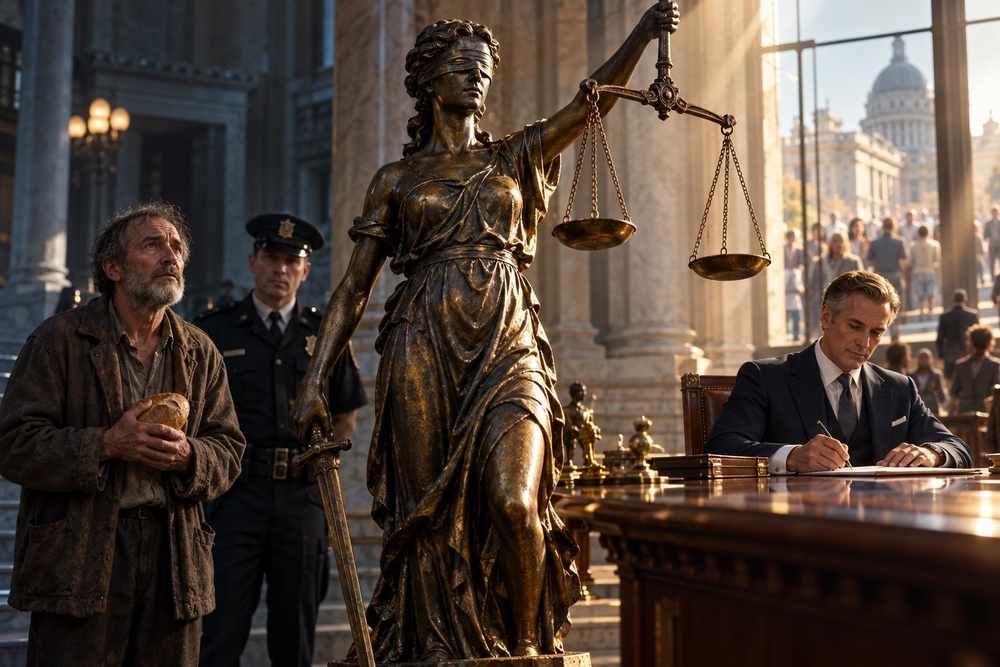
IS JUSTICE BLIND TO POWER?
When a person steals a loaf of bread, we call him a thief. But what do we call it when someone, with a single signature, takes away the rights of thousands of people?
There is a saying attributed to Machiavelli, although I have not been able to verify it in this form in his original works:
“If justice truly existed, prisons would be filled with politicians, not the poor.”
It would not be accurate to say that Machiavelli actually said this. But I think the more important thing is the question behind the statement:
Is everyone really equal before the law?
When a poor person steals something small out of desperation, the system quickly steps in. The police, the prosecutor, the courts... Someone is held accountable.
But injustice committed by a powerful person does not always come to light so easily.
Sometimes there is no weapon.
There is a signature.
There is a tender decision.
There is a contract.
There is a regulation.
And while all of these may appear perfectly legal on paper, thousands of people can still end up suffering as a result.
This is where the difference between power and crime becomes clear.
The powerless person breaks the law.
The powerful person may sometimes have the power to determine how the law is applied.
Of course, this does not mean that “the poor are innocent and the powerful are guilty.” A crime is a crime regardless of who commits it.
But when we evaluate justice, we need to look not only at how the powerless are punished, but also at how the powerful are held accountable.
Because if the law restricts the powerless but cannot touch the powerful, then even if we accept that the rule of law exists, we have every reason to ask serious questions about justice.
A small theft committed by an ordinary person is noticed immediately.
But a much greater injustice can sometimes disappear among contracts, corporations, bureaucratic procedures, and legal language.
One person steals from your pocket.
Another can steal from people's futures with a signature.
The first is called a crime.
The second may sometimes be recorded as a “legally proper procedure.”
I believe we should judge a state's justice not by the promises it makes, but by how it behaves when confronted with power.
Because the real test begins not when a powerless person commits a crime, but when a powerful person does.
Does justice really treat everyone the same?
Or is it more cautious in the presence of some people and more courageous in the presence of others?
Perhaps the most important question is this:
Is justice really blind, or does it know very well whom to look at and whom not to?
What do you think is the biggest problem with justice today?
Are the laws inadequate, or are the laws simply not applied equally to everyone?