
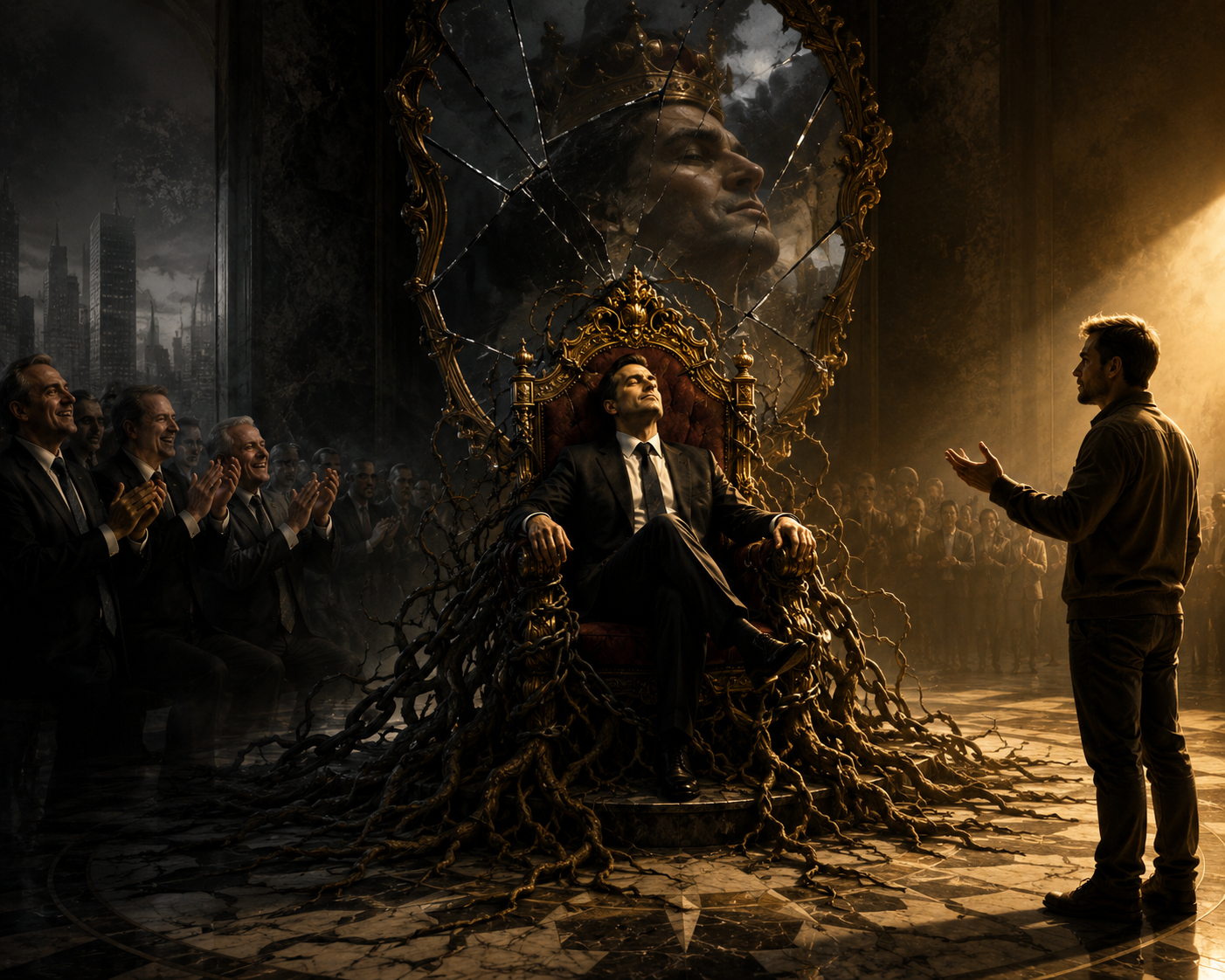
POWER INTOXICATION: THE ALIENATION OF THE SELF.
While recently discussing power and leadership in management with Prof. Dr. Feyzi Uluğ and Prof. Dr. Hasan Şimşek on the Education Heals YouTube channel, the concept of power intoxication briefly came up. That conversation prompted me to reflect more deeply on this phenomenon.
Power, in itself, is not evil.
A parent’s authority over a child, a teacher’s influence in the classroom, a manager’s responsibility to make decisions, or the regulatory authority of the state are not inherently problematic.
The real question is this:
How does power change a person?
Power does not simply take the shape of its container like water. More often, it reveals a person’s character, and sometimes, without notice, it quietly transforms it.
This is what we call power intoxication.
It rarely happens overnight.
No one wakes up one morning and says, “I have become arrogant.”
Instead, the poison spreads gradually.
First, a person begins to believe their own decisions are unquestionably correct.
Then criticism becomes uncomfortable.
Soon, dissenting voices are dismissed one by one.
Eventually, the individual begins to see themselves as standing above the very rules that once guided them.
The most dangerous aspect is this:
Power does not merely grant authority. It constantly generates approval.
Those who hold power are questioned less, applauded more, and forgiven more easily.
Over time, a dangerous illusion emerges.
A person’s own voice begins to sound like the voice of truth itself.
Power intoxication does not corrupt only those with bad intentions.
Its greater danger is that it can also transform good people.
This phenomenon is not limited to politics.
It can appear in a school principal, an academic, a business executive, a religious leader, or even the elder of a family.
The position changes.
The mechanism does not.
As power increases, humility should increase with it.
Yet, far too often, the opposite happens.
As authority grows, so does the ego.
The individual begins to see themselves as indispensable.
Yet time is the harshest corrector of that illusion.
Those once considered irreplaceable are often remembered later in only a few lines of history.
Perhaps the greatest illusion of power is believing it is permanent.
But no office lasts forever.
No chair belongs to anyone forever.
No applause continues indefinitely.
The moment people forget this, they stop managing power and begin to be managed by it.
The nineteenth century British historian Lord Acton expressed this timeless truth with remarkable clarity:
“Power tends to corrupt.”
Modern psychology reaches a similar conclusion.
Unchecked power reduces empathy, weakens critical thinking, and distorts the perception of risk.
In other words, the transformation begins not only in behavior, but within the mind itself.
That is why many wise leaders throughout history deliberately surrounded themselves with people who had the courage to say “no.”
Because the most valuable voice is never the loudest supporter.
It is the one courageous enough to speak the truth when it matters most.
Power intoxication destroys precisely this safeguard.
Criticism disappears.
Approval remains.
Gradually, reality fades.
The individual begins living inside an echo chamber where only their own voice can be heard.
Perhaps that is the deepest form of loneliness.
Power intoxication affects not only the individual but everyone around them.
People choose adaptation over honesty.
Merit gives way to loyalty.
Ideas surrender to fear.
And institutions begin to decay quietly from within.
Is there a way out?
Yes.
But it requires continual self-awareness.
A person must regularly ask:
“How much of what I hear is true, and how much is simply what others think I want to hear?”
Criticism should be welcomed not as an attack, but as a source of balance.
Most importantly, a person must never allow their identity to become inseparable from their position.
Because someone who loses themselves when they lose their title never truly possessed a stable sense of self.
True greatness is measured not by how many people we rule, but by how many lives we improve.
That is the real test of power.
To use authority not for personal glory, but for the benefit of others.
Because power does not make a person great.
It simply amplifies what already exists within them.