
TO POSSESS OR TO CARE?
Have we ever stopped to think about how often we use the word “mine” in life?
My house. My car. My job. My position. My student. My child. My spouse. My friend...
It is as if putting the word “my” in front of something automatically gives us a claim over it.
I don't really believe that.
Because over the years, I have come to see something quite clearly: possessing something and caring for it are two very different things.
You may have the deed to a house. But that house may not make your life any better.
You may hold an important position. But you may sit in that position for years without doing anything of real value for anyone.
You may have a child. But your child may still feel lonely when they are with you.
You may have known someone for years. But that does not necessarily make you their friend.
I believe that what we truly possess requires much more than simply having our name attached to it.
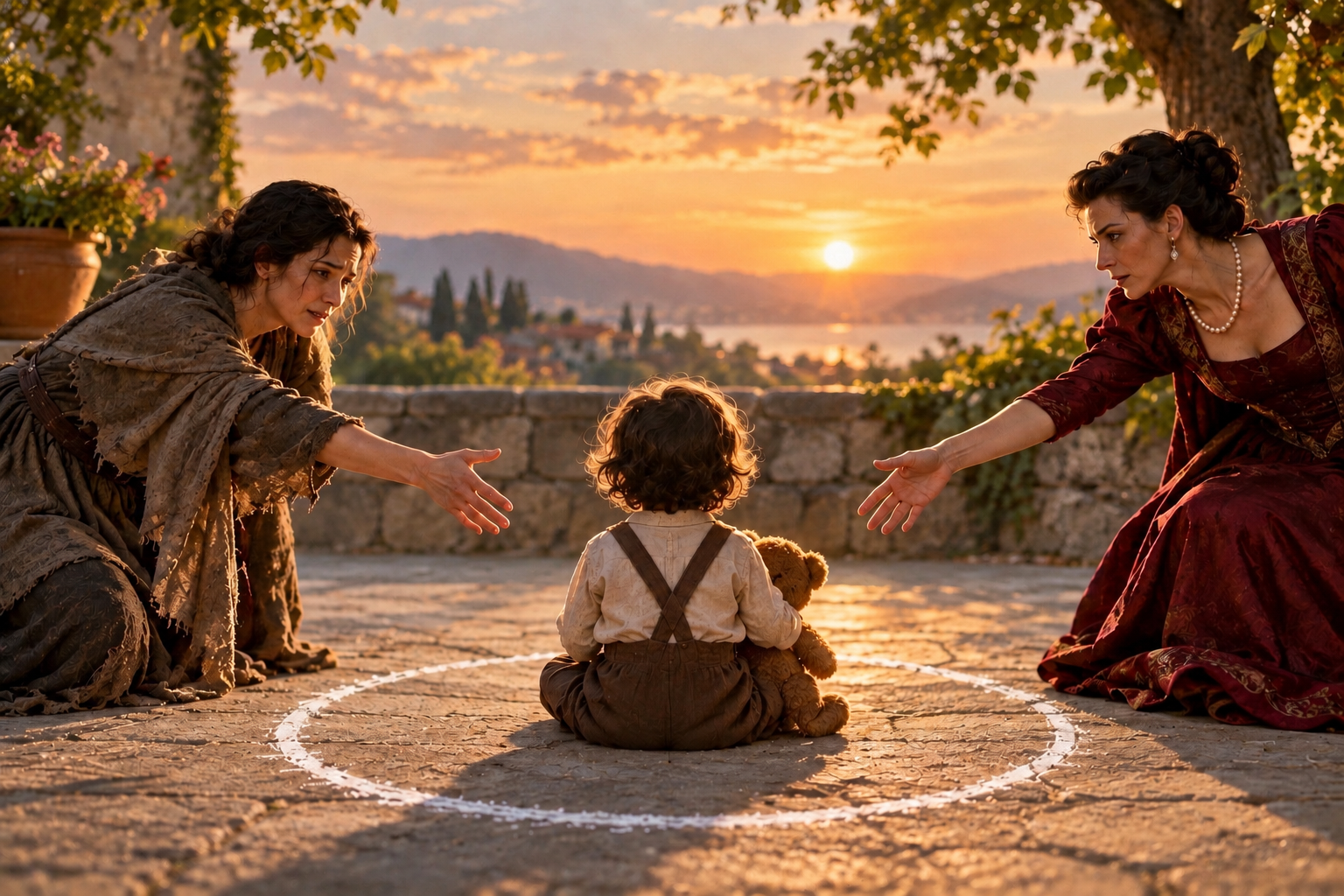
When I think of Bertolt Brecht's The Caucasian Chalk Circle, which I watched as a student at the METU School of Architecture auditorium, this is exactly what comes to mind.
The story in the play is actually quite simple, much like the stories we often see on Turkish television programs such as Müge Anlı ile Tatlı Sert. But it is also powerful enough to make you uncomfortable.
During a time of war and chaos, a mother abandons her child. A young woman named Grusha, however, refuses to leave the child behind. She takes him with her. She protects him, feeds him, raises him. She risks her own life for him. She goes hungry. She is afraid. She runs. She suffers. But she does not abandon the child.
Then everything changes.
The child's biological mother appears and demands her child back.
“I gave birth to him,” she says.
If you look at it purely from a legal point of view, the matter seems quite straightforward.
But life is not made up of law books alone.
And this is exactly where Brecht makes us uncomfortable.
Who does the child belong to?
The woman who gave birth to him?
Or the woman who was willing to risk her life for him?
At the end of the play, Judge Azdak draws a circle on the ground with a piece of chalk. He places the child in the middle and tells the two women to pull him toward themselves.
Whoever manages to pull the child out of the circle will get him.
But Grusha does not pull.
Because she knows it will hurt the child.
For me, this is where the real meaning of the play begins.
Grusha is willing to lose the child, but she is not willing to hurt him.
To me, that is exactly where the difference between love and possessiveness lies.
When we want to possess someone, we shout, “Mine!”
When we truly care for someone, sometimes we have to loosen our grip.
These are not the same thing.
In fact, most of the time, they are almost opposites.
I have seen so many examples of this in life.
I have seen parents trying to live their own lives through their children.
Parents who make decisions for their children while saying, “I'm only thinking about what is best for you.”
Parents who place their own unfulfilled dreams on their children's shoulders.
Parents who try to decide what profession their children should choose, whom they should marry, and even where they should live.
And then they call all of this love.
I have a hard time calling it love.
Because love is not about controlling another person's life.
Our children do not belong to us.
We may have brought them into this world. We may have worked for them and sacrificed for them for years. But eventually, they are human beings who have to live their own lives.
I think that is one of the hardest parts of being a parent: learning, one day, to let go of your child's hand.
Because raising a child is only part of parenting. Learning to set them free is another part of it.
If we cannot do that, we are not really caring for our children. We are simply tying them to ourselves.
Friendship is no different.
Over the years, I have met a great many people. There were people I sat at the same table with, laughed with, and called “my friend.”
But life has taught me enough to know that you don't really discover your friends when things are going well.
You discover them when things go badly.
When everything is fine, almost everyone can be there for you.
When your work is going well, plenty of people will call.
When you succeed, there will always be people ready to praise you.
But when things go wrong—or when you retire and withdraw into the quiet of your own home...
That's when things suddenly become quiet around you.
The phone rings less often.
Some people simply disappear.
Others remain by your side as if nothing has changed.
That is where I look for friendship.
Friendship is not so much about laughing together as it is about being able to sit together in silence.
I have also seen how dangerous the idea of “possession” can become in working life.
Sometimes a person becomes a manager and begins to think they own the people working for them.
They start believing that the bigger their position becomes, the bigger they themselves become.
But holding a position does not give you the right to look down on other people.
A manager is not there to control people's lives. A manager is there to create an environment in which people can do their work better and grow.
I observed this for many years in the university environment.
There were good managers.
And there were bad ones too...
Some used their positions to serve people.
Others believed that their positions gave them the right to see themselves as superior to everyone else.
I never accepted the second way of thinking.
Because managing people is not about possessing them. It is about carrying responsibility for them.
I believe that until we understand this distinction, we cannot become either good managers or good human beings.
We make the same mistake in society.
“My civil servant.”
“My minister.”
“This country is mine.”
“This city is mine.”
“This institution is ours.”
“This land is ours.”
All right.
If it really belongs to us, what are we doing with it?
Are we protecting it?
Are we treating people fairly?
Are we thinking about those who will come after us?
Or are we simply consuming what we call “ours” and leaving whatever remains for someone else?
To me, caring for something means exactly this.
It is easy to say that you love something.
The real question is whether you are willing to carry its burden.
If you say you love nature, then don't destroy it.
If you say you believe in justice, defend justice even when it works against your own interests.
If you say you love people, don't stand only beside the powerful.
Otherwise, our words mean very little.
Sometimes I think about all the things we call “mine” throughout our lives.
Most of them were never really ours.
Our children grow up and leave.
Homes change hands.
Positions change hands.
Money comes and goes.
People enter our lives and, sooner or later, somehow leave them.
There is no guarantee that the person standing beside us today will still be there tomorrow.
So why do we hold on so tightly?
I think the real issue is not what we possess.
It is how we behave while we have it.
What kind of mark did we leave on a child's life?
Were we there when a friend was going through a difficult time?
Did we truly make a difference in one of our students' lives?
Did we merely give orders to an employee, or did we help that person grow?
If we earned someone's trust, did we know how to protect it?
To me, this is where real wealth lies.
After a while, it doesn't matter very much how many houses we own, how many cars we have, or what position we hold.
People don't remember us for those things.
They remember us more for how we made them feel.
The older I get, the more I think about this.
Whenever we enter someone's life, we leave a mark there—good or bad.
Sometimes without even realizing it.
A small thing we say to a child can stay in that child's mind for years.
Giving a student an opportunity can change the course of that person's entire life.
Being there for a friend on their hardest day may never be forgotten.
The opposite is true as well.
People we have hurt may not forget us either.
A harsh word may take only a few seconds for us to say, but it can live inside another person for years.
That is why I believe we should think twice before saying “mine.”
Because perhaps no person really belongs to us.
Our spouse does not belong to us.
Our child does not belong to us.
Our friend does not belong to us.
Our employees do not belong to us.
They are people with lives of their own, their own choices, their own fears, and their own dreams.
What we can do is not control their lives.
We can try to make their lives better.
Sometimes by being there.
Sometimes by offering support.
Sometimes by showing them a way forward.
Sometimes by saying nothing and simply waiting.
And, when necessary, by letting go of their hand.
That is, in part, what Grusha does in The Caucasian Chalk Circle.
She does not pull the child toward herself.
Because she is thinking about the child, not about herself.
For me, that is the real power of the play.
Because a person's deepest love does not reveal itself when they say,
“I don't want to lose you.”
It reveals itself when they can say,
“I would rather lose you than see you hurt.”
That is not easy.
In fact, I'm not even sure most of us are capable of it.
But perhaps that is part of what love really means.
When we want to possess someone, we hold on tightly.
When we truly care, sometimes we loosen our grip.
Because we know that the person in front of us is not an object.
They have their own path.
Their own life.
Their own right to choose.
In the end, this is what I believe:
The things we truly possess are not the things listed on a property deed, in a bank account, or in official records.
What we truly possess is the mark we leave on other people's lives.
If we have held someone's hand...
If we have protected a child...
If we have not abandoned a friend...
If we have brought even a little light into a student's life...
If we have been able to give up something we wanted in order not to hurt another person...
Those are the things that belong to us.
Most of the rest are simply things that were given to us for a while.
Perhaps that is why it is better to ask ourselves not,
“What do I have?”
but rather,
“What have I truly cared for?”
Because saying “mine” is easy.
The difficult part is taking responsibility for whatever we call ours.
And sometimes, if you really love someone, instead of pulling them toward yourself...
you have to be able to let go of their hand.
🙈