
WHEN JUSTICE FAILS, BEING RIGHT IS NOT ENOUGH
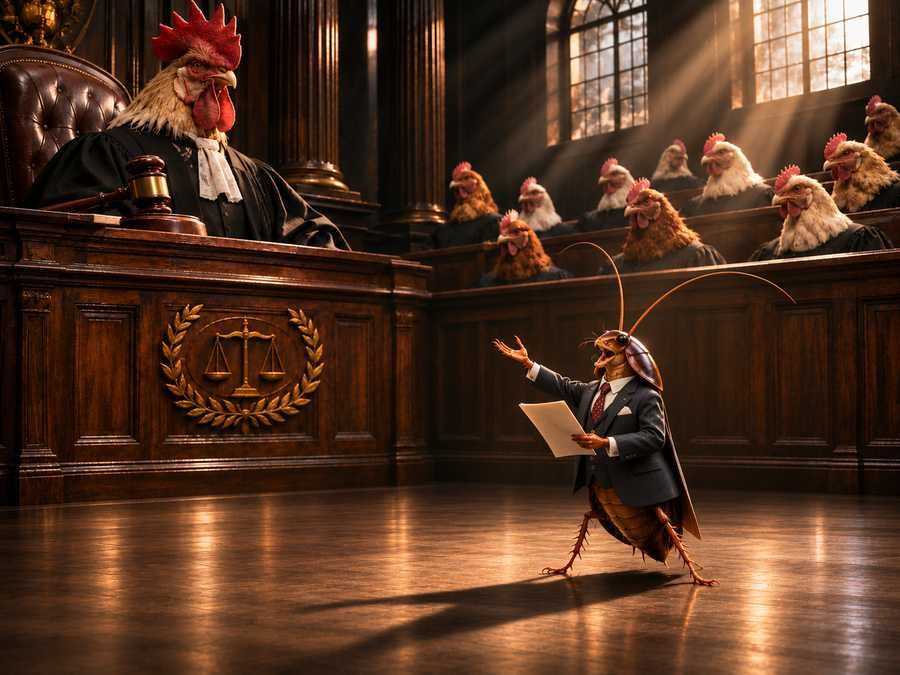
There is a saying: “A cockroach can never win a case in a courtroom run by chickens.”
At first, this comparison may bring a smile to our faces, but it actually conveys a rather serious truth. Sometimes, what a person says, what they do, or even what evidence they present makes no difference. That is because those sitting across from them are not there to determine whether they are right or wrong; they are simply there to validate a decision they have already made.
In such a courtroom, the cockroach faces a jury of chickens. The judge, the witnesses, and the jury members all belong to the same coop. They know one another, share the same world, and see things from the same perspective. No matter how convincingly the cockroach defends itself, the outcome is already decided if those listening have no intention of delivering a fair verdict.
We see similar situations in everyday life.
In workplaces, universities, families, and society at large, some people are assigned a particular place before they even have a chance to speak. Decisions have already been made about who is trustworthy, who is troublesome, who is successful, and who is incompetent. From that point on, identical behaviors are judged differently depending on who displays them. One person’s mistake is met with understanding, while another’s slightest error is treated as proof of a flawed character. One person’s success is applauded, while another’s is dismissed as mere luck.
In such environments, no matter what people say, they struggle to make themselves understood. This is because those listening are not trying to understand; they are merely looking for confirmation of their own beliefs.
This is precisely what makes prejudice so dangerous. People do not simply hold mistaken opinions about others; they begin interpreting everything they see through the lens of those misconceptions. They readily accept evidence that supports their existing beliefs while ignoring anything that challenges them.
Things become even more complicated in environments where power relations determine the rules. The explanation offered by someone powerful may be considered reasonable, while the defense of someone powerless may be dismissed as an excuse. One person’s objection may be interpreted as courage, while another’s is labeled disrespect. Thus, a vast gap emerges between being right and being able to convince others of one’s righteousness.
Of course, believing that we are right in every disagreement does not necessarily mean that we actually are. Sometimes we are mistaken; sometimes we make decisions based on incomplete information. Justice requires us to question our own thinking when necessary. But this requires a willingness to listen to one another, consider the evidence, and apply the same standards to everyone.
For a courtroom to be fair, having laws and rules is not enough. Those who enforce them must also be impartial. The same principle applies to universities, workplaces, families, and societies. Justice means evaluating people not according to who they are, which group they belong to, or whom they associate with, but according to their actions and the facts.
Perhaps the most important lesson we can draw from this little animal story is this: Justice is not a privilege granted exclusively among those who share the same views. True justice means being able to listen without prejudice even to someone who is different from us, thinks differently, or even stands in opposition to us.
Because what determines whether a person is right is not whom they stand against, but what the truth actually is.
If cockroaches keep losing in a society, before questioning their defenses, we should first take a closer look at who makes up the courtroom.