
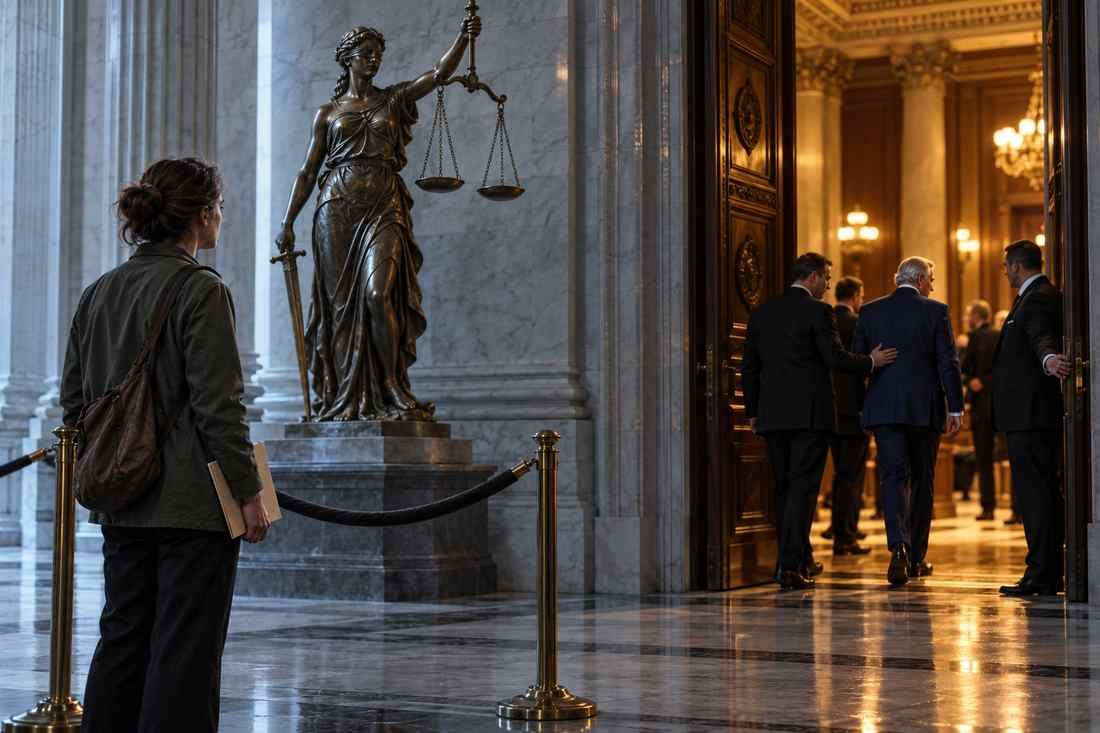
WHO DOES THE LAW PROTECT?
A person does not necessarily have to be treated unfairly in a courtroom to lose faith in justice. Sometimes, all it takes is a news report.
You see an investigation that drags on for years, a case that goes nowhere, a corruption allegation that everyone is talking about, or the impression that someone powerful never seems to be held accountable. Then you hear people around you saying the same thing:
“Nothing will happen to us. They have people behind them.”
That is where the real danger begins.
Because the law is an ordinary person's most important safeguard. You may not have money, a position of power, political influence, or well-connected friends. Yet you still believe that your rights will be protected. That is the basic promise of the rule of law.
But when citizens begin to believe that the law functions less as a shield for them and more as a shield for those who hold power, they lose more than faith in a particular case. Their trust in the system itself begins to erode.
A statement that has stayed with me captures this feeling:
“Laws were made to protect us from the corrupt. But as I see it today, the laws protect the corrupt from us.”
It is a harsh statement. But I think what matters most is not its harshness, but the question it raises:
Whose side is the law on?
Of course, law and justice are not the same thing.
The law defines what constitutes a crime and establishes the rules people are expected to follow. Justice, however, requires those rules to be applied by the same standard to everyone.
A country may have thousands of laws. It may have imposing law books, detailed regulations, and functioning courts. But if citizens believe that the rules change when they come up against someone powerful, then the real problem is not the existence of laws. It is the trust people place in them.
Throughout my academic career, I have encountered people, institutions, and different approaches to management. I have learned that people do not always expect to get the outcome they want. Sometimes even someone who believes they have been treated unfairly can accept the outcome if they believe the process itself was fair.
But something else is far more damaging:
“What difference will it make if I stand up for my rights?”
Once that thought takes root, people lose hope before they ever reach the courtroom.
Then something else begins to change.
When an honest person sees that those who ignore the rules seem to get ahead more easily, they begin to question their own behavior.
“Why don't I do the same?”
“Why should I struggle so much to defend my rights?”
“If everyone else is doing it, why shouldn't I?”
I can hardly think of a more serious sign of moral erosion in a society.
Because the damage caused by corruption is not limited to the money that disappears. There is another loss:
The desire of honest people to remain honest.
When the person who “knows how to get things done” is actually someone who knows how to circumvent the rules; when someone who stands up for their rights is seen as a troublemaker; and when someone who follows the rules is considered naïve, eventually even the meaning of words begins to change.
Things that people once felt ashamed of become things they boast about.
“That's how it is everywhere.”
“That's how the powerful operate.”
“You'd do the same if you were in their shoes.”
These statements tell us a great deal about where a society's moral standards have settled.
For me, one of the most important functions of law is not only to punish those who commit wrongdoing, but also to make it possible for honest people to remain honest.
If a person has two paths before them one based on integrity and the other on personal gain and the system consistently rewards the second, then simply telling people to “be honest” eventually means very little.
Honesty must have a payoff.
Justice must also be visible.
People need to believe that their rights can actually be protected.
Otherwise, the law becomes nothing more than a set of rules that exists in books.
In my view, the success of a good legal system should not be measured only by how many people are punished. Its real success lies in whether an ordinary citizen, when faced with a problem, can honestly say:
“If I stand up for my rights, something may actually come of it.”
That sentence may sound simple. But it is enormously important for the future of a society.
Because the first thing law should give people is trust.
And if people ever begin to fear trusting the law more than they fear lawlessness, then we are facing something far more serious than a legal problem.
What has been lost is much greater than a single case or a single file:
People's sense of justice.