
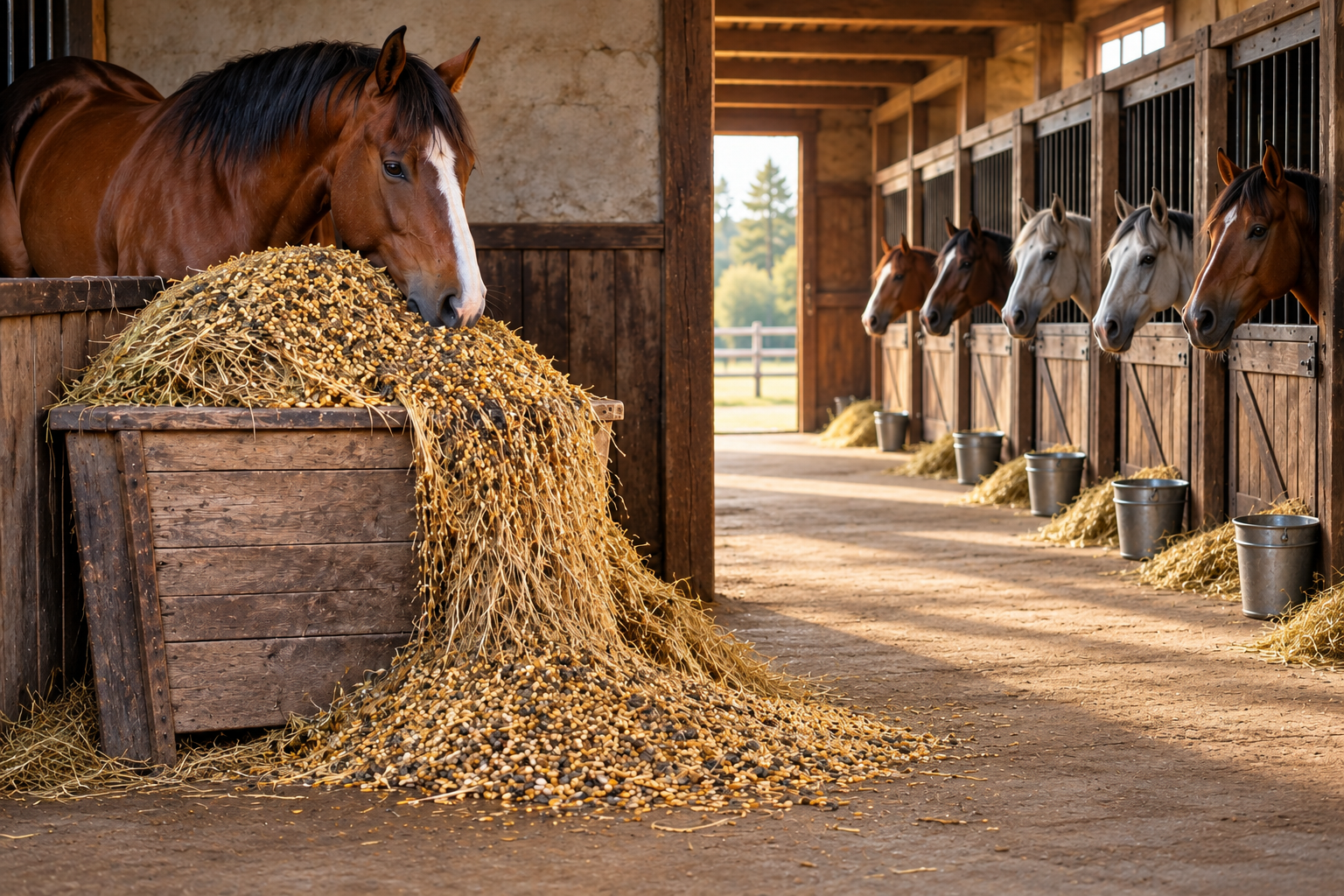
FEEDING ONE HORSE THE FEED MEANT FOR TWENTY
As we grow older, we begin to see some things differently.
I used to assume that someone who talked a lot was knowledgeable, that someone who helped a lot was kind, and that someone who loved intensely was sincere. I don't make those judgments so easily anymore.
Over time, I've learned something simple:
Just because there is more of something doesn't mean it is better.
Too much attention can overwhelm a person.
Too much advice can silence them.
Too much help can make them dependent.
And too much power can distort a person's sense of proportion.
Perhaps one of the hardest things in life is learning how much of something is enough. A joke I heard years ago illustrates this better than any theory could.
Kamil Efendi was a stableman who looked after horses. One Friday, he went to the mosque and noticed that there was no one there. The imam, preparing to deliver his sermon, saw that he had only one person in the congregation and asked Kamil Efendi:
You're the only one here. What do you think? Should I give the sermon or not?
Kamil Efendi replied:
I'm just a stableman. I don't know much about these things. I have twenty horses. If all twenty ran away and only one remained, I wouldn't neglect that one. I'd still feed and look after it.
The imam took this as sufficient encouragement and began his sermon. And he didn't keep it short. He went on for quite a while.
After the prayer, he turned to Kamil Efendi:
Well, what did you think? Did you like my sermon?
Kamil Efendi gave a short answer:
I'm just a stableman. I don't know much about sermons. But I wouldn't give one horse all the water and feed meant for twenty and make it burst.
I smile whenever I hear this story.
But the more I think about it, the more that smile fades. Because, at times, we all resemble that imam.
When we start explaining something to someone, we often don't stop to ask how much they actually need. We want to tell them everything we know. If we're right, we want to defend our position to the very end. If we've gained experience in something, we sometimes begin unloading our own experiences onto the other person, as though the longer we talk, the greater our influence will be.
But often the opposite happens.
When a person keeps talking after they've run out of anything worth saying, they begin to use up the value of what they've already said.
I saw this many times during my academic career. It was true in the classroom, in meetings, and in relationships. At some point, explaining stops being teaching and becomes simply listening to the sound of one's own voice.
Perhaps that is one of the differences between a good teacher and a teacher who simply talks a lot.
A good teacher doesn't fill a student's mind with his own knowledge. He leaves some space for the student to think.
Because education isn't about how much information you put into a student's head. It's about how much thinking you awaken in it.
Family life is no different.
We try to control our children's every step so they won't make mistakes. We think we're protecting them. But sometimes, under the name of protection, we begin living their lives for them.
When a friend is going through a difficult time, we are quick to offer advice. Yet perhaps what that person needs isn't a solution at all. Maybe they simply need someone to sit beside them and listen.
When someone close to us makes a bad decision, we sometimes wait for the opportunity to say, “I told you so.”
But sometimes what a person needs isn't another warning even a correct one. What they need is a safe place where they can face their own mistake.
Help is like that, too.
Even help has a proper measure.
Taking someone's hand is one thing.
Starting to walk for them is another.
Too much help can stop being help and become interference.
I suppose this is one of the things we learn most clearly as we grow older:
Not every truth needs to be spoken everywhere.
Not everything we know needs to be told to everyone.
Not every act of help needs to be offered every time.
Sometimes we need to step back.
Sometimes we need to remain silent.
Sometimes we need to say, “I don't know.”
And sometimes we need to allow another person to make their own mistake.
Because people are shaped not only by what we tell them, but also by what we choose not to tell them and leave for them to discover on their own.
Kamil Efendi's simple wisdom as a stableman seems to me to be addressed not only to that imam, but to all of us:
You don't give one horse the feed meant for twenty.
Because even good intentions have limits.
If you love someone, don't suffocate them with your love.
If you know something, don't feel compelled to tell them everything you know.
If you have power, don't use it every chance you get.
If you can help, don't turn every opportunity into an intervention.
And if you have a lot to say, stop for a moment and ask yourself:
“Does this person really need to hear this, or am I saying it simply because I want to say it?”
I think maturity begins somewhere around here.
Life doesn't just teach us how much we can give. It teaches us how much is enough.
Because sometimes, while trying to nourish someone, we don't satisfy them we overwhelm them.
Sometimes, while trying to do good, we cause harm.
Sometimes, while trying to show someone the way, we end up blocking their path.
And sometimes even a beautiful thought loses its beauty when we add a few sentences too many.
Kamil Efendi's simple wisdom, born from years of tending horses, perhaps captures something that academic books cannot:
Every living thing has a capacity.
A horse has one.
So does a child.
A student.
A friend.
Perhaps we do, too.
The day we understand that, we begin treating both others and ourselves a little better.
Because the real question isn't simply how much we give.
The real question is whether we know how much to give and when to stop.