
THE VILLAGE THAT DROVE OUT ITS HONEST GUARDIANS
Sometimes, you don't need a long investigation to understand how a society becomes poor, how its institutions fall apart, or why honest people increasingly find themselves alone. A simple story can tell us a great deal about the problems facing an entire country.
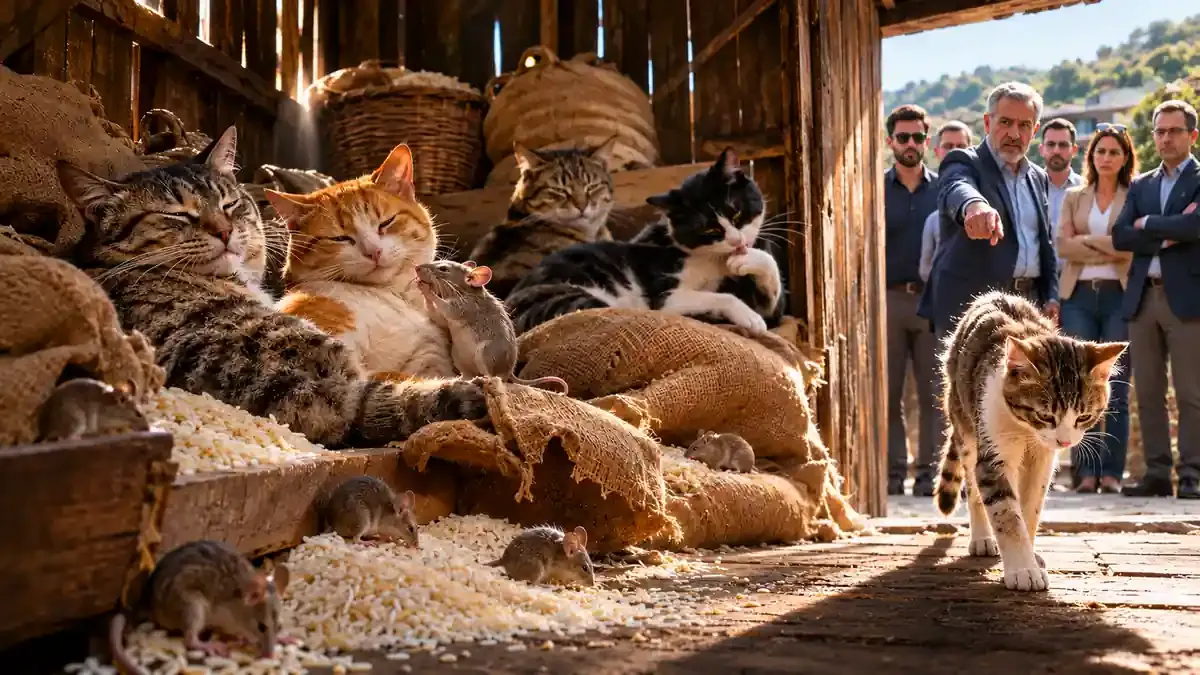
In a village, the people hired a cat to protect their rice storage from mice. Their purpose was simple: to keep the mice from eating the rice and to protect the village's shared resources.
In return, the villagers fed the cat every day. On its first night, the cat caught a mouse. Just as it was about to eat it, the mouse whispered in its ear:
“It's better for you to let me go. If you catch all the mice, the villagers won't need you anymore. You'll be out of a job, and they'll stop feeding you. But if you let us eat a little rice, the storage will never be completely empty. The villagers will continue to feed you because they'll still need you as their protector.”
The cat thought about what the mouse had said and let it go.
The next morning, the cat went to the villagers and told them that the storage was overrun with mice and that it couldn't handle the problem alone. So the villagers hired a few more cats to help.
But the new cats made exactly the same deal with the mice. The mice continued eating the rice, while the cats pretended to catch them and happily consumed the food provided by the villagers. The strange thing was that the more cats the villagers hired, the faster the rice disappeared.
One day, a young cat came along. Unlike the others, it took its job seriously and actually caught a mouse. The other cats panicked when they saw this. After all, the young cat wasn't simply catching a mouse. It was threatening to bring down the entire arrangement they had built.
They immediately went to the villagers and complained about the young cat. They claimed it was dangerous and threatened the safety of the other cats. The villagers believed the majority and drove the only honest guardian out of the village.
And so the village continued to grow poorer because of the very guardians it had hired to protect it.
When we read this story, it's hard not to think about what happens in some societies and institutions. The real issue here isn't simply that mice eat rice or that cats abuse their responsibilities. It's about how wrongdoing gradually becomes accepted as normal.
In social sciences, this is often described as the normalization of corruption. When dishonest practices continue for a long time within an institution, people gradually stop questioning them. Things that were once considered unacceptable become part of everyday life. Eventually, those who behave honestly may even be seen as naïve, strange, or troublemakers who disrupt the established order.
That's because, in an environment dominated by self-interest, honesty is no longer just a personal virtue. It becomes a threat to the interests of others.
Think about it. If one person uses public resources for personal gain, that's a crime. But what happens when more and more people do the same thing, protect one another, and even gain influence over the very institutions responsible for overseeing them? We're no longer dealing with isolated cases of individual wrongdoing. An entire system of mutual interest has taken shape. Everyone knows what everyone else is doing, but nobody speaks up. After all, if one person is held accountable, the others may have to answer for their actions, too.
That's where the real danger begins.
In such an environment, merit loses its importance and personal loyalty takes its place. Privilege replaces fairness, and mutual protection replaces accountability. People are judged not by the quality of their work or what they achieve, but by whom they know and which group they belong to.
Honest people find it increasingly difficult to survive in such a system. They don't simply refuse to take part in dishonest gains; their very presence challenges others to give up those gains as well. That's why even the presence of an honest person can make some people uncomfortable.
Eventually, things reach a point where those who benefit from corruption protect one another, while those who expose it—often journalists—are blamed. People who tell the truth are accused of creating trouble, those who demand accountability are treated as enemies, and those who simply do their jobs honestly are portrayed as dangerous.
Yet a society's strength cannot be measured by its wealth alone. What really matters is how it uses its resources and how well it protects the values it shares.
Public resources are limited. Every amount of money stolen, wasted, or diverted for personal gain takes something away from society's future. It means fewer resources for education, healthcare, science, justice, and people's quality of life. And more often than not, the people who pay the price aren't those who benefit from corruption, but ordinary citizens who work hard and pay their taxes.
That's why we can't explain a country's growing poverty simply by saying it lacks resources. Sometimes the real problem is how those resources are used and whose interests they serve.
The village's storage wasn't becoming empty because it was too small. It was becoming empty because those responsible for protecting it had started feeding themselves from what they were supposed to guard.
There's an important lesson we can take from this story:
“Hiring more guards is not enough to solve a society's problems. First, we need to ask whom those guards are really serving, whether they are actually doing their jobs, and who is responsible for holding them accountable.”
For this, we need more than good leaders. We also need strong institutions, independent oversight, a free press, a functioning legal system, and citizens who are willing and able to demand accountability. No system can survive on people's good intentions alone.
And perhaps just as importantly, we must not leave honest people to stand alone. When honesty remains merely an individual virtue, it can easily be crushed. But when society stands behind those who act honestly, it becomes a shared value and a safeguard for its institutions.
Now, let's ask ourselves a question:
“What's the real danger to a society: the mice eating the rice in the storage house, or the cats who are supposed to catch them but instead make deals with them and drive the honest guardians out of the village?”
Let's not forget that the existence of thieves is dangerous enough, but a system that protects them is even more dangerous. In fact, that's often the greater threat. One person who steals causes damage to public resources. But a system that protects theft destroys society's sense of justice, people's trust in one another, and their faith in the future.
A society's real poverty is not that there is no rice left in its storage house. It is that it can no longer keep honest people by its side to protect what belongs to everyone.